
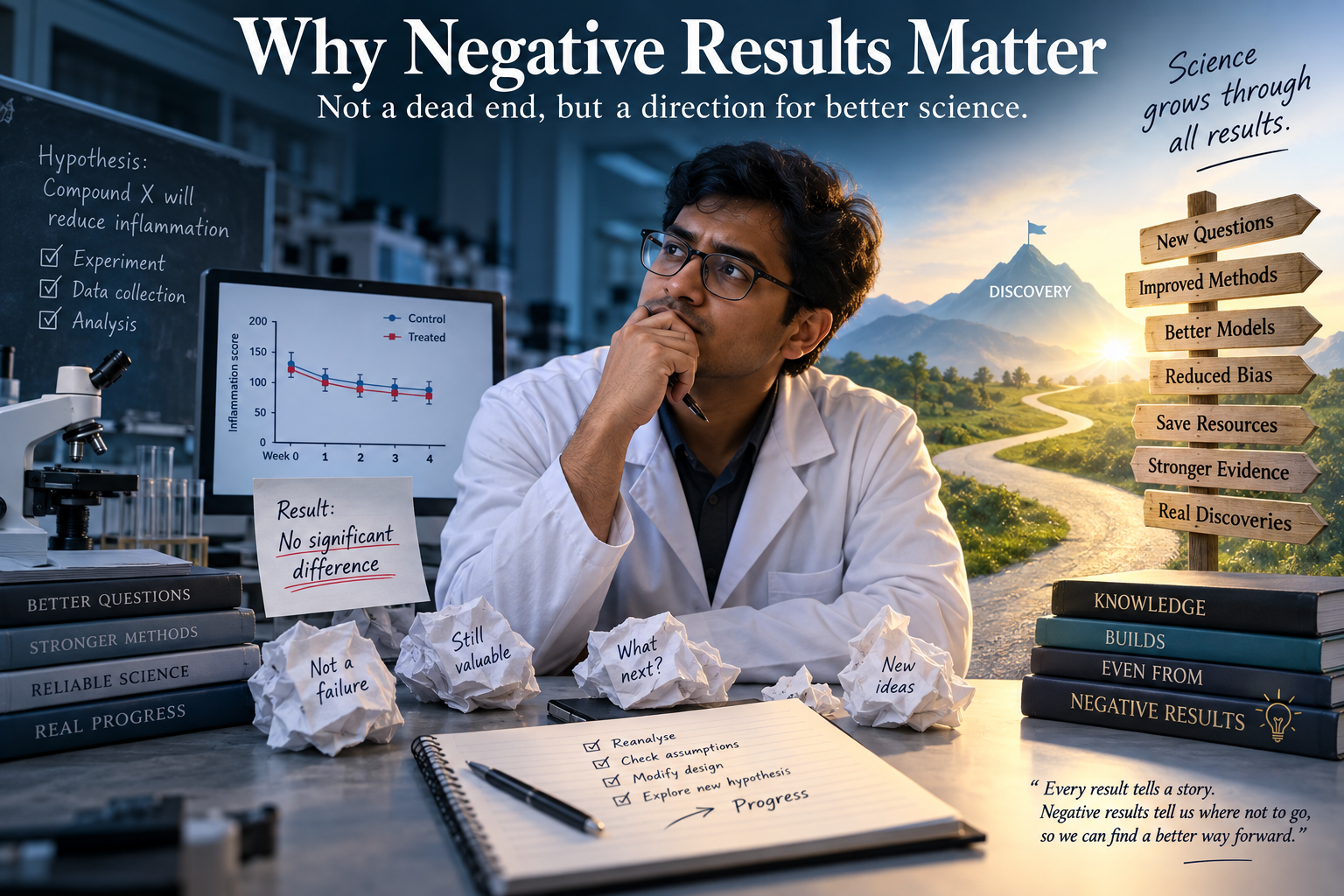
Introduction: Science Does Not Always Give the Answer We Expect
Scientific research is often presented as a straightforward journey from a question to a discovery. A researcher develops a hypothesis, designs an experiment, collects data, performs statistical analysis, obtains a significant result, and eventually publishes the findings. This familiar picture can create the impression that successful research must end with confirmation of the original hypothesis. Real scientific research, however, rarely follows such a simple path. Experiments frequently produce results that do not support what researchers initially expected. A drug candidate may fail to produce the anticipated therapeutic effect, an intervention may perform no better than a control, two variables expected to be associated may show little evidence of a relationship, or a promising computational prediction may not survive experimental validation. After months or even years of work, the conclusion may simply be that the expected effect was not observed.
These findings are commonly described as negative results, null results, or non-significant findings. Because modern research culture often places considerable emphasis on novelty, statistically significant findings, successful hypotheses, publications, and citations, researchers may feel disappointed when their results are negative. In some cases, they may even regard the entire project as a failure. Scientifically, however, that interpretation can be deeply misleading. Research exists not to prove that our expectations are correct but to determine what the evidence actually supports. A rigorous study that demonstrates that an expected effect could not be detected under defined experimental conditions has still generated knowledge. Science advances not only by discovering what works, but also by identifying what does not work, where an explanation fails, and which assumptions require reconsideration.
Negative Results Are Not the Same as Failed Experiments
One of the most important distinctions in research is the difference between a negative result and a failed experiment. Suppose researchers hypothesize that a particular compound reduces anxiety-like behavior. They select an appropriate experimental model, establish suitable control groups, justify the doses, follow a standardized protocol, collect reliable measurements, and analyze the resulting data using appropriate statistical methods. If the treated group does not demonstrate convincing improvement compared with the control group, the original hypothesis has not been supported. Nevertheless, the experiment itself may have been conducted perfectly well. It asked a legitimate scientific question and produced evidence relevant to that question. The answer was simply different from what the researchers expected.
A failed experiment is fundamentally different. If samples become contaminated, equipment malfunctions, important controls fail, the experimental protocol is seriously violated, data are lost, or the selected methodology is incapable of answering the research question, then reliable interpretation may not be possible. In such situations, the problem lies in the experiment rather than in the direction of the result. This distinction is crucial because a carefully conducted experiment can produce a negative result, while a poorly conducted experiment can produce an apparently positive result. Scientific quality therefore cannot be judged by whether the final result is positive or negative. It must be judged by the quality of the research question, study design, methodology, data, analysis, transparency, and interpretation.
A Hypothesis Is a Question, Not a Result That Must Be Proven
Researchers sometimes become emotionally attached to their hypotheses. After reading the literature, designing an experiment, securing resources, and spending months collecting data, it is natural to hope that the predicted relationship will appear. Yet a hypothesis should never become a conclusion that the researcher feels obligated to prove. A hypothesis is a scientifically testable proposition. The experiment determines whether the available evidence supports it, contradicts it, or remains insufficient to reach a confident conclusion.
Consider a researcher who proposes that Compound A has anti-inflammatory activity. After experimentation, the expected reduction in inflammatory markers is not observed. That result immediately opens several scientifically meaningful possibilities. Compound A may genuinely lack substantial activity in the tested system. The selected dose may have been inadequate. Its bioavailability may have been poor. The experimental model may not represent the biological condition in which the compound acts. The proposed molecular target may have been incorrect. The compound may influence another pathway that was not measured. Alternatively, an earlier positive finding may have overestimated the true effect. A negative result therefore does not necessarily close the investigation. Instead, it can transform a relatively simple question—“Does this compound work?”—into a more informative one: “Why was the expected effect not observed under these conditions, and what does this tell us about the underlying biology?”
Negative Results Challenge Scientific Assumptions
Science advances by continuously testing assumptions against evidence. Theories, mechanisms, pathways, and models are useful because they allow researchers to make predictions. However, a prediction becomes scientifically meaningful only when it can potentially be shown to be wrong. Negative findings perform this critical function. They identify situations in which an existing explanation fails to predict what actually happens.
Suppose a computational study predicts that a ligand interacts strongly with a therapeutic target. Molecular docking, molecular dynamics simulations, or other computational analyses may suggest a favorable interaction. If subsequent biological experiments fail to demonstrate the expected activity, the discrepancy should not simply be dismissed. It may reveal an important limitation in the original model. Strong predicted binding does not automatically guarantee biological efficacy. Absorption, distribution, metabolism, excretion, target accessibility, membrane permeability, protein dynamics, dose, competing biological pathways, off-target interactions, and many other factors may influence the final biological response. The negative experimental result therefore contributes something important: it defines the boundary between what the computational model predicted and what the biological system actually demonstrated. Such contradictions are often scientifically productive because they force researchers to improve their models.
Negative Results Protect Science from Publication Bias
One of the strongest reasons for valuing negative results is their relationship with publication bias. Imagine that ten independent research groups investigate the same hypothesis. Three studies report statistically significant positive findings, while seven studies find little or no convincing evidence of the proposed effect. If the three positive studies are published but the seven negative studies remain unpublished, anyone reviewing the literature will encounter a seriously distorted picture. The published evidence may appear to show consistent support for the hypothesis even though most completed studies did not reproduce the expected effect.
This imbalance can influence much more than individual readers. Systematic reviews, meta-analyses, clinical decisions, research priorities, grant proposals, and future experimental programs may all depend on the published literature. If negative findings are systematically underrepresented, the apparent magnitude or reliability of an effect can become exaggerated. Publishing rigorous negative findings therefore helps create a more complete scientific record. The objective is not to publish every poorly designed study simply because it produced a non-significant result. Rather, scientifically sound studies should not disappear merely because their conclusions are less exciting than anticipated.
Negative Results Prevent Unnecessary Repetition
Research consumes considerable resources. Laboratory reagents, experimental animals, cell cultures, analytical instruments, computational infrastructure, participant time, research personnel, funding, ethical-review capacity, and months or years of work may all be required to answer a single scientific question. When a rigorous negative result remains inaccessible, other researchers may unknowingly repeat the same unsuccessful approach.
Imagine that one laboratory spends several months evaluating a candidate molecule using a specific dose, model, route of administration, and experimental protocol and finds no meaningful activity. If those findings are never communicated, another laboratory may repeat almost exactly the same experiment. A third laboratory may later do the same. The problem is not replication itself—replication is essential to science—but uninformed duplication can waste resources when previous evidence could have guided a better experiment. A properly documented negative study tells future researchers that a particular approach has already been tested under defined conditions. They can then modify the dose, choose another model, investigate a different mechanism, improve the methodology, or redirect resources toward a more promising question. Knowing where evidence has failed to support an approach is therefore part of knowing where science should go next.
Negative Results Can Improve Experimental Design
A negative finding should trigger critical analysis rather than immediate abandonment of a project. Researchers should ask whether the hypothesis was sufficiently justified, whether the experimental model was appropriate, whether the sample size provided adequate precision, whether the dose and duration were reasonable, whether the positive and negative controls behaved as expected, whether the measurement method was sufficiently sensitive, whether important confounding variables were controlled, and whether the statistical analysis matched the structure of the data. These questions can reveal weaknesses that may not have been obvious when the experiment was initially designed.
This process illustrates an important feature of scientific progress. Research rarely moves in a straight line from hypothesis to confirmation. More commonly, a hypothesis leads to an experiment, the experiment produces an unexpected result, the unexpected result exposes a limitation, and that limitation leads to a refined hypothesis and a stronger subsequent experiment. A negative result can therefore function as feedback. It tells researchers not merely that an expectation was unsupported, but also where the next investigation may need to become more precise.
A Non-Significant Result Does Not Automatically Mean “No Effect”
One of the most common mistakes in interpreting negative results is assuming that a statistically non-significant finding proves that no effect exists. Suppose a comparison produces a p-value greater than 0.05. It is tempting to conclude that the intervention has no effect or that the two groups are identical. Such conclusions may go beyond what the evidence actually demonstrates. A non-significant result may occur because the true effect is absent or extremely small, but it may also occur because the sample is too small, variability is high, measurements are imprecise, statistical power is limited, or the estimated effect is accompanied by considerable uncertainty.
Researchers should therefore interpret negative findings by examining more than a conventional significance threshold. Effect size, confidence intervals, sample size, study design, data quality, biological plausibility, prior evidence, and practical significance all contribute to interpretation. The statement “we did not detect a statistically significant difference” is not automatically equivalent to “we demonstrated that there is no difference.” Similarly, if the objective is to demonstrate that two treatments are meaningfully equivalent, simply failing to obtain a significant difference is generally insufficient; an appropriately designed equivalence or non-inferiority approach may be necessary. Careful interpretation prevents negative findings from being overstated just as careful interpretation should prevent positive findings from being exaggerated.
Negative Results Strengthen Reproducibility
Reproducibility is central to trustworthy science. A finding becomes more convincing when independent researchers can investigate the same phenomenon and obtain compatible evidence. However, replication studies do not always reproduce the original positive result. Those negative replication findings are scientifically important because they help determine how robust, generalizable, and condition-dependent the original claim really is.
Suppose an influential study reports a strong biological effect. Several independent groups later attempt to replicate the experiment but observe much smaller effects or no convincing effect at all. These results create an opportunity to examine why the findings differ. The original effect may depend on a specific population, laboratory condition, analytical decision, model, dose, environmental factor, or measurement technique. The initial estimate may also have been unusually large. Alternatively, methodological differences between the studies may explain the discrepancy. Science becomes more reliable when these disagreements remain visible rather than when only successful replications enter the literature. Reproducibility does not require every experiment to produce identical results; it requires researchers to be able to examine the total evidence transparently.
Negative Results Have Ethical Importance
The importance of negative findings becomes particularly clear when research involves humans or animals. Human participants may accept inconvenience, uncertainty, or risk because their participation is expected to contribute to scientific knowledge. Animal experiments similarly carry ethical responsibilities to justify animal use and avoid unnecessary repetition. When scientifically valid results are never communicated because they are negative, some of the informational value generated by that research is lost.
Making rigorous negative findings available can therefore contribute to more ethical planning of future research. Investigators can determine which approaches have already been attempted, which doses or interventions were ineffective under particular conditions, and where additional experimentation is genuinely justified. This does not eliminate the need for replication, but it helps ensure that replication is informed rather than accidental. If an ethically conducted experiment has produced reliable evidence, that evidence should not become invisible simply because the hypothesis was unsupported.
Why Researchers Are Often Reluctant to Report Negative Findings
Despite their scientific value, negative results face practical and psychological barriers. Researchers may believe that journals prefer novel, statistically significant, or dramatic findings. Students may worry that a thesis containing non-significant results will appear weak. Investigators may fear that an unsupported hypothesis reflects poorly on their scientific ability. Career incentives based on publication numbers, citations, grants, and perceived impact may further reinforce the idea that positive findings are more valuable.
There is also a human element. Researchers invest intellectual effort and emotional energy in their ideas. When an experiment confirms an expectation, the result can feel rewarding. When it does not, disappointment is natural. Scientific integrity, however, requires researchers to separate their expectations from their observations. The purpose of an experiment is not to make the hypothesis win. It is to allow evidence to determine whether the hypothesis survives the test. A researcher who transparently reports a well-designed study that contradicts their own expectation is demonstrating scientific discipline, not scientific weakness.
Negative Results Must Still Meet High Scientific Standards
Recognizing the importance of negative findings does not mean that every experiment producing p > 0.05 deserves a strong scientific conclusion. A result is only as informative as the study that produced it. If an experiment uses inadequate controls, unreliable measurements, an inappropriate model, extremely small samples, serious protocol deviations, or unsuitable statistical analyses, both positive and negative findings may be difficult to interpret.
The central question should therefore be whether the study was capable of answering the research question with reasonable reliability. Researchers should evaluate the precision of estimates, quality of measurements, adequacy of controls, assumptions underlying statistical analyses, and methodological limitations before drawing conclusions. Negative results should be subjected to the same rigorous standards as positive results. The scientific community should value good negative evidence, not merely negative numbers.
Negative Results Should Never Be Forced into Positive Results
Pressure to obtain statistically significant findings can create dangerous incentives. Suppose a researcher performs the planned analysis and obtains p = 0.08. Another analysis gives p = 0.06. The researcher then excludes certain observations, tries multiple subgroups, changes outcomes, modifies analytical approaches, or repeatedly tests different combinations until p = 0.04 appears. If these decisions were driven primarily by the desire to obtain statistical significance and are not scientifically justified or transparently reported, the final positive result may be misleading.
The correct response to an unexpected or non-significant finding is not to force the data to support the original expectation. Researchers should investigate the result, verify data quality, conduct justified sensitivity analyses, distinguish exploratory from confirmatory analyses, and report relevant decisions transparently. A negative result may be inconvenient for a manuscript, but manipulating analytical choices to manufacture a positive result damages the reliability of the scientific record. Scientific credibility is far more valuable than obtaining a convenient p-value.
Negative Results Can Lead to Unexpected Discoveries
A result can be negative relative to the original hypothesis while simultaneously opening an entirely new direction of research. Consider a researcher investigating whether a natural compound produces neuroprotective effects. The expected behavioral improvement is not observed. Initially, the experiment appears disappointing. However, secondary observations reveal an unexpected change in another biological pathway. Further investigation suggests that the compound may influence a mechanism unrelated to the original hypothesis. The original prediction was unsupported, yet the experiment generated a new scientific question.
This pattern is common throughout research. Observations that do not fit existing expectations often force researchers to look more carefully at the system they are studying. Unexpected findings can reveal previously overlooked mechanisms, interactions, limitations, or conditions. Scientific discovery is therefore not simply the accumulation of confirmed predictions. It is a continuous interaction between what researchers expect and what nature actually reveals. Negative results are one of the mechanisms through which that interaction produces new knowledge.
How Researchers Should Respond to a Negative Result
When a negative result appears, the first response should be investigation rather than disappointment. Researchers should verify that the experiment functioned as intended by reviewing raw data, controls, protocol adherence, equipment performance, data-processing procedures, and statistical assumptions. They should then examine the magnitude and uncertainty of the observed effects rather than focusing exclusively on statistical significance. Comparison with previous literature is also essential because earlier studies may have used different populations, doses, models, endpoints, analytical methods, or experimental conditions.
The researcher should then distinguish among several possible interpretations. The hypothesized effect may genuinely be absent under the tested conditions. The effect may exist but be smaller than anticipated. The study may lack sufficient precision to distinguish a small effect from random variation. The effect may depend on a biological or experimental condition that was not represented in the current study. These interpretations have very different implications, and the available evidence should determine which conclusions are justified. Transparent reporting is essential throughout this process. Researchers should avoid rewriting hypotheses after observing the results, concealing inconvenient outcomes, or presenting exploratory analyses as though they had been planned from the beginning.
Science Needs to Know What Does Not Work
Imagine a scientific literature in which only successful experiments were visible. Every investigated compound would appear active, every intervention beneficial, every biomarker predictive, and every proposed mechanism supported. Such a literature might look impressive, but it would provide a profoundly unrealistic representation of science. Biological, chemical, clinical, behavioral, and social systems are complex. Many plausible hypotheses will ultimately prove incomplete, context-dependent, or incorrect. That is not a weakness of science. It is precisely why hypotheses need to be tested.
Negative findings provide the resistance that prevents scientific knowledge from becoming a collection of unchallenged assumptions. They define the boundaries of theories, identify ineffective approaches, reveal uncertainty, expose methodological limitations, and redirect researchers toward more productive questions. Sometimes the most useful conclusion a study can provide is that a particular approach should not be pursued further without substantial modification. That information may save other researchers years of work.
From “Publish or Perish” to “Evidence Matters”
Modern academic culture often measures productivity through publications, citations, journal prestige, grants, and other visible indicators. Although these metrics can serve useful purposes, they can also create an environment in which researchers perceive positive and novel findings as inherently more valuable than negative ones. A healthier scientific culture would evaluate research using a more fundamental question: did the study generate trustworthy evidence that meaningfully reduces uncertainty?
If the answer is yes, the research may be valuable regardless of whether the original hypothesis was supported. Reliable knowledge can tell us that an intervention works, that it does not appear to work under particular conditions, or that the available evidence remains too uncertain to reach a strong conclusion. Each outcome contributes differently to scientific understanding. The ultimate objective of research is not to produce statistical significance. It is to produce evidence that allows us to understand reality more accurately.
Conclusion: Sometimes “It Did Not Work” Is the Discovery
Negative results should not be viewed as the opposite of scientific discovery. They are an essential part of the process through which discovery becomes reliable. A positive finding may tell researchers that a phenomenon exists and deserves further investigation. A negative finding may reveal that an existing explanation is incomplete, that an intervention is ineffective under certain conditions, that a model needs refinement, or that a different question should be asked. Both outcomes can reduce uncertainty and influence what researchers do next.
The real danger in science is therefore not a negative result. The greater danger is a result that is hidden, selectively reported, exaggerated, or manipulated simply because it does not match the researcher’s expectations. Scientific progress depends on allowing evidence to challenge our assumptions. A researcher does not fail when a well-designed experiment produces an unexpected answer. Science works precisely because nature is allowed to disagree with us. Sometimes the statement “It did not work under these conditions” is not the end of the research story. It is the most important piece of information the next experiment needed.